
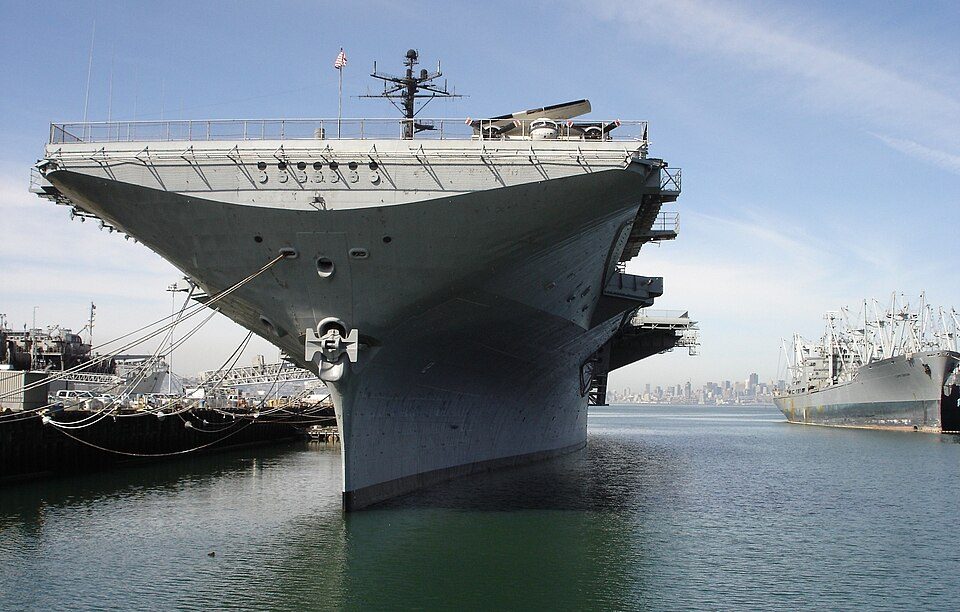
The USS Hornet Museum is a decommissioned Essex-class aircraft carrier moored at Alameda Point in Alameda, California. The ship fought in World War II, recovered the Apollo 11 and Apollo 12 crews, and now serves as a museum on San Francisco Bay. This guide covers the ship's history, its role in the Apollo program, and its ties to Alameda's naval aviation past.
The USS Hornet’s Operational History
USS Hornet (CV-12) was built by Newport News Shipbuilding in Virginia and commissioned on November 29, 1943. The Navy first planned to name the ship Kearsarge. After the earlier USS Hornet (CV-8) was lost at the Battle of the Santa Cruz Islands, the new carrier took its name. The ship displaces about 27,100 tons at standard load and measures roughly 872 feet long.
Hornet saw combat in the Pacific in 1944 and 1945. According to the USS Hornet Museum, the ship earned nine battle stars and a Presidential Unit Citation in World War II. Its air groups flew strikes against targets in the Marianas, the Philippines, Formosa, Okinawa, and Japan.
The museum credits the ship's aircraft with shooting down 668 Japanese planes and sinking 73 enemy ships in 18 months of combat operations. At one point a typhoon with 120-knot gusts heavily damaged the flight deck, and the ship launched aircraft off its stern for a time.
The Navy decommissioned the carrier in 1947 and later recommissioned it. Modernization programs strengthened the flight deck for jet aircraft and added an angled flight deck. In the 1960s Hornet served as an anti-submarine warfare carrier, and on its Vietnam cruises it spent much of its time on search and rescue support. The Navy decommissioned the ship for the last time in 1970.
The Apollo Recovery Missions
Hornet's best-known role came in July 1969. The Navy selected the carrier, then based in Long Beach, California, as the prime recovery ship for Apollo 11, the first crewed Moon landing. The ship sailed to Hawaii and spent about two weeks on the recovery cruise.
The command module Columbia splashed down on July 24, 1969, about 12 miles from the ship. Navy divers from Underwater Demolition Teams attached a flotation collar to the capsule, and a decontamination swimmer wiped down the astronauts' isolation suits.
A helicopter then lifted astronauts Neil Armstrong, Michael Collins, and Buzz Aldrin from the raft and landed them on the flight deck. President Richard Nixon was aboard during the recovery. The ship's commanding officer, Captain Carl Seiberlich, also commanded all Pacific recovery forces for the mission.
The astronauts then stayed in a Mobile Quarantine Facility, a modified Airstream trailer, as part of NASA's biological isolation procedures. Columbia was moved off the ship for processing and later flown to Houston. NASA keeps the full record of the Apollo 11 mission.
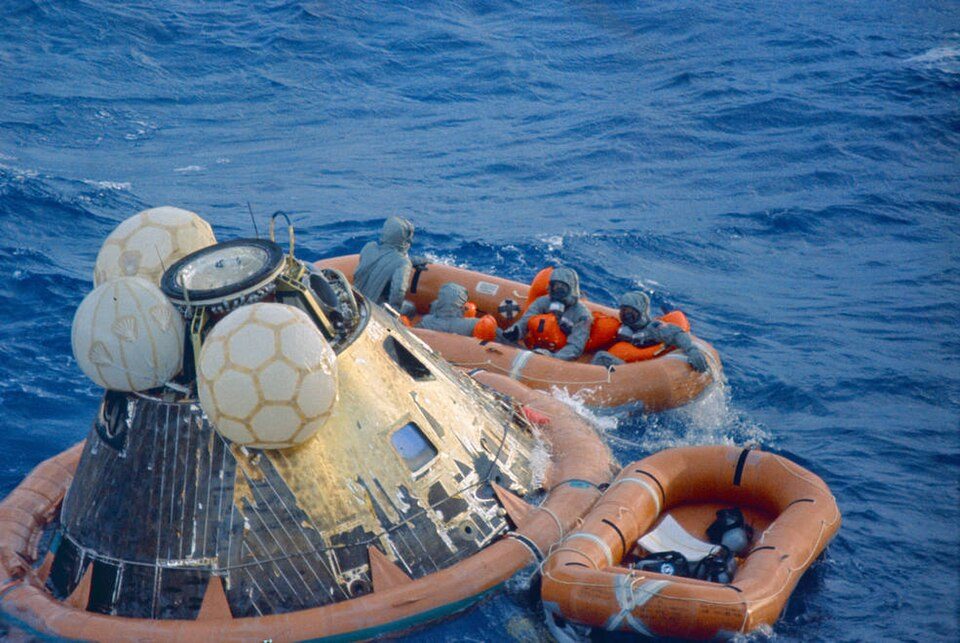
Hornet also recovered the Apollo 12 crew in November 1969. Pete Conrad, Alan Bean, and Richard Gordon splashed down in the command module Yankee Clipper a little over two miles from the carrier. Earlier, in 1966, the ship had recovered the uncrewed Apollo AS-202 capsule.
Today the museum's Apollo Splashdown exhibition includes a Grumman model of the lunar module, mementos made for the crew, and memorabilia from the era, according to the museum.
Naval Air Station Alameda and Alameda Point
The ship's berth is at Alameda Point, the former Naval Air Station Alameda. The Navy operated the base from 1940 until it closed in 1997. The museum ship opened to the public in Alameda in 1998, giving the old base a permanent landmark. The ship's flight deck and hangar bay now host visitors and public events.
Alameda's Weather and Visiting Conditions
Alameda has mild weather all year, which suits a museum with large outdoor decks. NOAA's 2006 to 2020 climate normals for Oakland Metro International Airport, a station near Alameda, show a July average high near 72°F and a January average low near 42°F. The station records about 16.5 inches of precipitation a year, and most of it falls between November and April.
Summer fog and afternoon wind are common on the Bay. A light layer is useful on the flight deck even in July.
Why the Museum Matters to Alameda
The USS Hornet is a National Historic Landmark and is listed on the National Register of Historic Places, according to the museum. For many Alameda families, the ship is a visible link to the island's naval history. Visitors can check hours, tickets, and tours on the museum's visitor information page before planning a trip.
← Back to all articles


